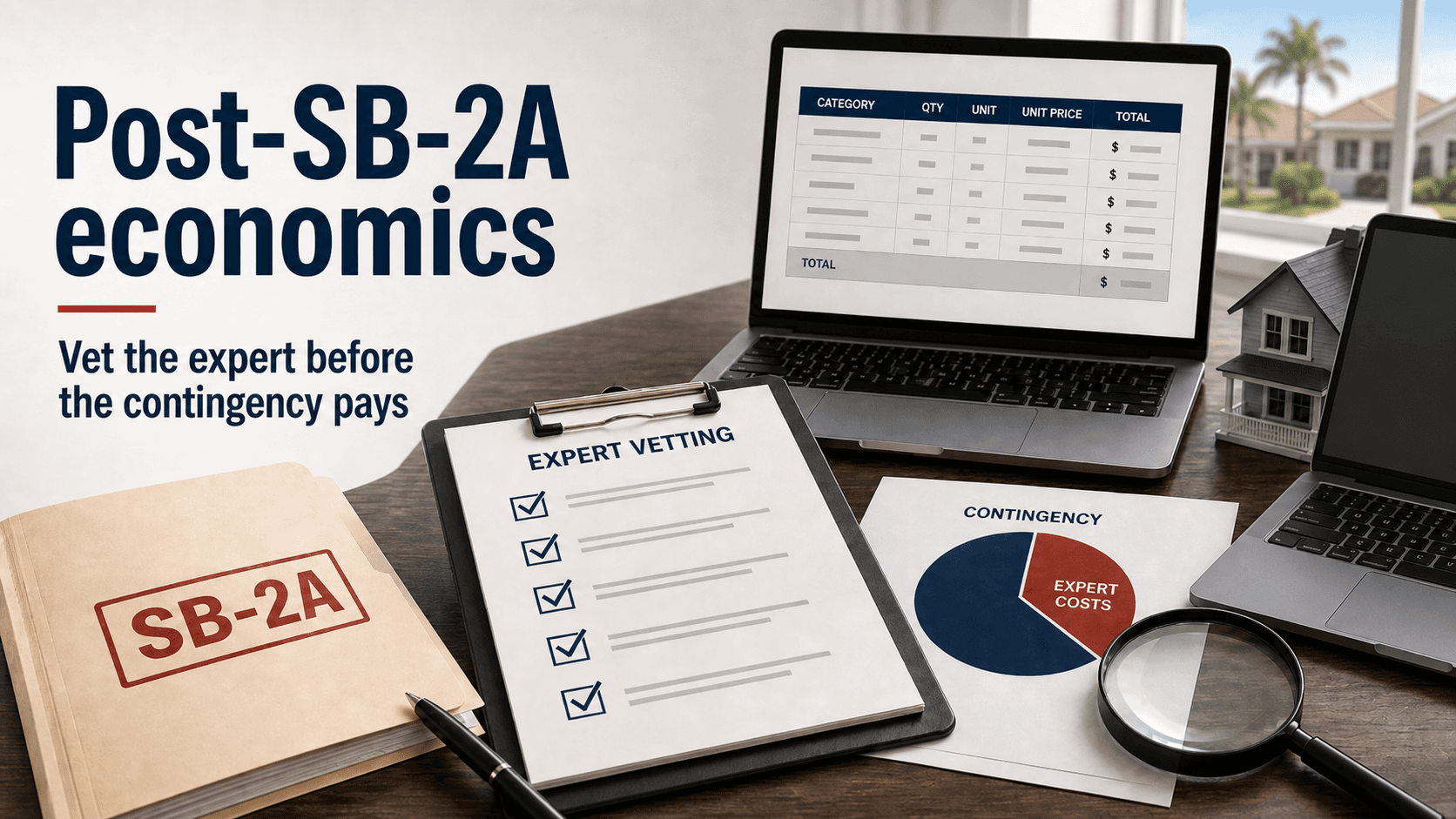
The economics of Florida property litigation changed in December 2022, and most of the operational adjustments are still working through the market. SB-2A eliminated one-way attorney fees in property insurance disputes. The carrier no longer reimburses the policyholder's attorney fees on a successful claim. Expert witness costs that used to be passed through to the carrier on a win now come directly out of contingency.
The downstream effect on case selection has been visible in the data. Florida property litigation volume dropped roughly 25% in the first half of 2025. Citizens new suits dropped 34% in the same window. The cases that get taken now are different cases. The expert decisions made on those cases now matter differently.
This is not a piece about whether SB-2A was good policy. It's about what changed in case math, and how to vet an estimating expert against that math.
What SB-2A actually changed in your case math
Before SB-2A, expert costs sat on the carrier's side of the ledger if the case was won. The result was that an attorney could justify hiring a more expensive expert on a marginal case because the cost wasn't going to come out of the recovery if things went well. The expert's role was, in many practices, partially decoupled from the case's economics.
After SB-2A, expert costs are part of the contingency arithmetic from intake. Two practical consequences follow:
Cases under roughly $50,000 disputed value lost their economic viability for most practices. The combined cost of expert engagement, deposition preparation, and trial readiness eats too much of the recovery to leave a contingency that justifies the case. Several Florida property litigation firms have moved their case acceptance threshold up to $75,000 or $100,000 in disputed value.
The selection of the expert becomes a forecast of cost certainty, not just a forecast of competence. An expert whose hourly rate is unpredictable, whose deposition behavior is unfamiliar, or whose deliverables tend to require revision is now an expert whose engagement risks blowing the contingency math on the case.
The vetting question, post-SB-2A, is no longer "can this person do the work." It is "can I forecast this person's total cost-to-resolution within a tolerance that lets me run my business."
Why the cheapest estimating expert is the most expensive choice
The cheapest hourly rate is rarely the cheapest expert. The expert who underbids the engagement and then needs supplements, revisions, and emergency calls runs total cost above the expert who quoted accurately at intake.
The same applies to deposition behavior. An expert who is calm, prepared, and tight on cross-examination uses time efficiently. An expert who improvises, contradicts their own report, or has to be re-prepped between sessions burns hours that come out of contingency.
The pattern that costs Florida property attorneys the most money in the post-SB-2A environment is not selecting an expensive expert. It is selecting an expert based on hourly rate without forecasting total engagement cost across the case lifecycle.
The Daubert filter: facts, methods, application
Florida adopted the Daubert standard for expert testimony in 2019, replacing the older Frye standard. Under Daubert, an expert's testimony must be based on:
- Sufficient facts or data — the expert must have direct evidence to ground the opinion
- Reliable principles and methods
- Reliable application of those methods to the facts
The practical implication for estimating experts is operational, not academic. An estimator who has never personally inspected the property cannot reliably testify under Daubert about the conditions of the property. They can testify about the methodology of the estimate. They cannot testify about what the building looked like, what the damage looked like, or what the appropriate scope of repair would be — because those opinions require direct factual grounding the expert does not have.
This is why estimators who only work remotely cannot serve as litigation experts on cases that go to deposition or trial. The case will be challenged at the Daubert level. The carrier's defense expert — typically from a firm like Donan, Rimkus, or Madsen Kneppers, all of whom inspect personally — will testify that the policyholder's expert never saw the property and therefore cannot reliably opine on its condition. The motion to exclude has high probability of success.
The vetting question this raises: does the estimating expert you're considering personally inspect the property, with documented inspection report, before signing the estimate? If the answer is no, the expert is appropriate for some roles in the file but not for the testimony role.
Twelve questions to ask any estimating expert before they touch your file
These questions are not exhaustive. They are the operational vetting filter that screens out the engagements that tend to go sideways post-SB-2A:
On qualifications:
- What certifications do you hold, with current dates, and which of those certifications are required for the type of loss in this case (water, fire, mold, structural)?
- How many estimates have you personally written and signed, in your name, that have been entered into Florida property litigation?
- Have you been deposed as an estimating expert in Florida? How many times? On what types of losses?
On methodology:
- Do you personally conduct the on-site inspection, or does another team member? If another team member, how is the chain of custody on observations documented?
- Will your final report include a separate Audit Report and Variation Report consistent with Florida Rule 69BER24-4?
- What ANSI/IICRC standards do you reference for mitigation work? How do you handle citations to standards versus operational application of them?
On Florida specifics:
- What current edition of the Florida Building Code do you cite from, and how do you handle local ordinance variations?
- How do you document matching law arguments at intake, before the carrier has had an opportunity to challenge?
- How current is your understanding of post-SB-2A and Rule 69BER24-4 procedural requirements?
On the economics of the engagement:
- What is your blended cost projection for the full case lifecycle, including deposition prep, deposition, and trial testimony at the rates you would charge?
- What is your turnaround commitment on the initial estimate, and what is your supplement turnaround?
- If the case settles before deposition, what portion of the engagement cost is unrecoverable?
These twelve questions take roughly 20 minutes to walk through. The answers tell you most of what you need to know about whether the expert fits your case math.
Red flags from a cross-examination perspective
The carrier's defense team will run their own version of the vetting process during deposition. Knowing what they look for is useful because it overlaps significantly with what you should look for.
A defense team will look for inconsistencies between the report and the testimony, methodology that cannot be defended under questioning, and any sign that the expert has not personally seen the conditions they are opining on. The expert who fails on cross-examination usually fails on one of three things:
Inconsistency between the written report and the verbal testimony. The expert wrote one thing in the report and is now saying something different on the stand. This usually happens when the expert did not personally write the report — when staff drafted it and the expert signed off without reading carefully.
Inability to explain methodology in conversational terms. The expert can recite line items but cannot explain why this categorization rather than that one, why this code section applies, why this reference to a standard rather than another. The defense theory is that the expert is reading a script they don't understand. Often it is correct.
Direct admission of not having seen the property. "I didn't personally inspect the loss; my team did" is fatal in most Florida property cases. The Daubert challenge follows immediately.
These red flags are visible in vetting if you ask the right questions and listen for the texture of the answers. They do not appear only in deposition.
How a Trial Pack works
WorldClass Estimates operates a Trial Pack offering specifically for property litigation attorneys. The structure is three on-site Named Estimates at evaluation rate. No retainer. No annual commitment. The estimates go on real files in your active practice — not hypothetical work.
Each estimate is signed in WCE's name, includes the Audit Report and Variation Report mandated by Rule 69BER24-4, and is delivered with the methodology disclosure required for litigation use. The estimator who signs the report is the estimator who personally conducts the on-site inspection and is committed to deposition availability for the case.
If the work survives the process — if your cases settle stronger, if the estimates hold up under carrier challenge, if the deposition support reads as professional — there's a Practice Pack conversation about a recurring engagement structure. If it doesn't, we shake hands. The structure is designed to remove the risk of an unfamiliar expert on real cases.
The vetting questions in this article apply to that engagement, the same way they apply to any other.